Resiliency and Growth
I am an only child; growing up, I had a lot of time to construct my own imaginary worlds, as well as to inhabit the worlds created by my favorite authors. I was so absorbed by some of the stories I read that I still remember vivid details: sitting on the stairs of my parents’ living room weeping when I reached the heartbreaking end of Where the Red Fern Grows, or staying up late turning the dog-eared pages of the paperback edition of Lonesome Dove. These seminal works charted my passage through childhood and adolescence, and I recently reread both books to remember what captivated me in these narratives.
In Where the Red Fern Grows, I admired Billy’s bravery in going against his family’s wishes and making the money to buy his own hunting dogs, Old Dan and Little Ann; I could relate to the fierce love he felt for his dogs and that they felt for each other. I read this story aloud this fall with my son, and we both dissolved in tears when (spoiler alert) Little Ann slowly wastes away from heartbreak at the loss of Old Dan. I could identify with the child in me who recognized the challenge in bucking her own parents’ expectations, and who was terrified to lose the people/animals she loved. Both my parents’ fathers died in their adolescence. Those losses were largely unprocessed in the family system; death was not spoken of but loomed large as a fear for me.
In rereading Lonesome Dove this winter, I fell in love once again with Augustus “Gus” McCrae and was enthralled by the story of adventure and loss that unfolds over the book’s 850 pages. The characters in Lonesome Dove grapple with issues that I see now were front and center in my teenage years: how to leave the familiar and strike out on a new journey, how to navigate power and divided loyalties in shifting relationships, how to accept the unpredictability of fortune.
Perhaps I turned to these stories again because I am perched on what feels like a new chapter of transition and loss. My oldest went off to college this year, and my parents are aging. At times, I find myself going back to my child strategies of resisting change. The NeuroAffective Relational Model™ (NARM®), has challenged me to see how — in my desire to avoid loss — I keep myself stuck and miss new opportunities for connection. In my younger years, I fell for the romanticized notion, so often portrayed in Hollywood, that there would be a moment of arrival in my life; that after a period of struggle and searching, I would find my happily ever after. The challenging truth that there is never a point of arrival — that the only constant is change – is not easy to accept. At the same time, it has been important to recognize that I have already faced many of the fears that felt overwhelming to me as a child: that my relationship with my parents would change, that I would need to forge my own identity, that I would be responsible for creating a new family and community. I try to remember the agency I have in seeing change not just as loss, but as a new adventure that will bring new learnings and connections. Loss is an inevitable part of life, but NARM® has helped me lean into the fact that we are wired for struggle. Furthermore, navigating struggle means we develop a growing faith in our own capacity to face the “not knowing” with courage and resourcefulness.
Signed,
Relax, Reset & Recharge Retreat, plus NARM® Workshop @ ROOTs
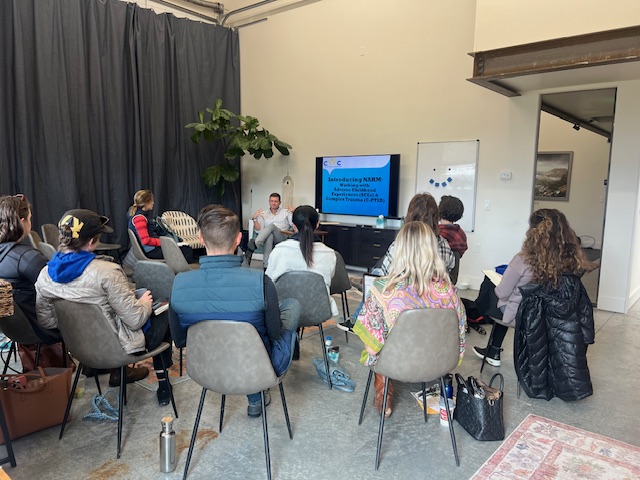
On Friday, April 18th, ROOTs offered our neighbors and fellow helping professionals a chance to exhale in our nourishing space while earning 2 Continuing Education Credits! Participants enjoyed a free yoga and meditation class, followed by lunch and the Introduction to NARM® workshop. Stay tuned here for opportunities to connect in May!
Now Accepting Applications for Enrollment
Reach out to Lauren for more information, or to schedule a tour.